Launching ‘Empowering Communities’ at CORTH
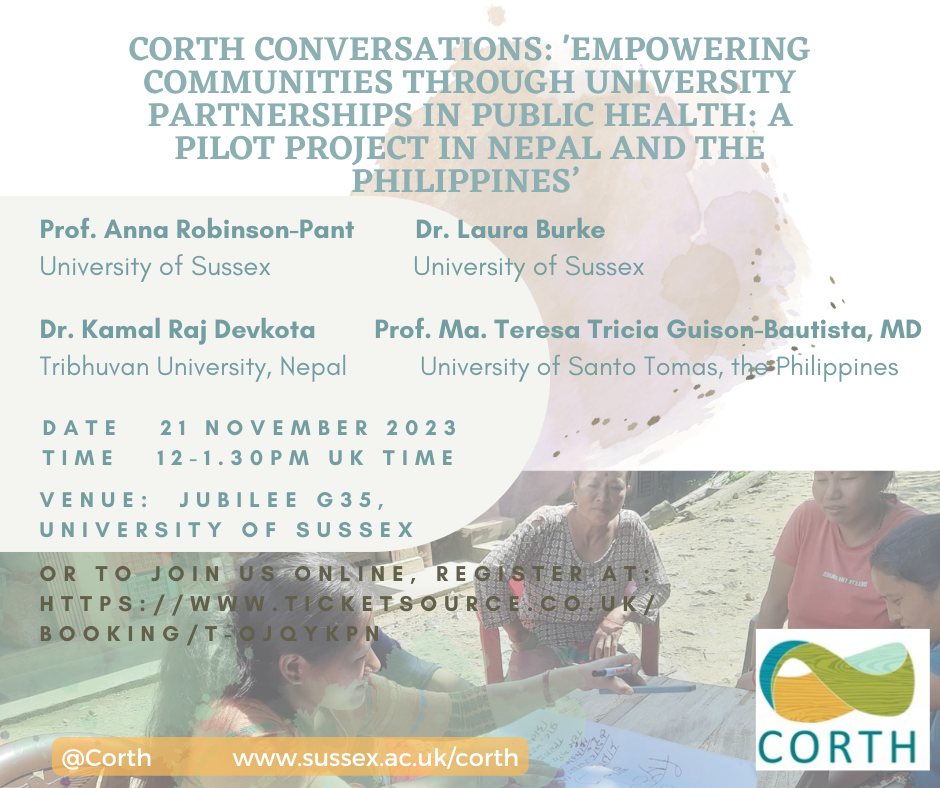
Amy Collyer, School of Global Studies, University of Sussex, UK.
In many parts of the world, communities have had little voice in national public health initiatives. Health providers often take a top-down approach, ‘preaching’ to families about how they should live more healthy lives and ignoring their everyday realities.
Partnering with universities in Nepal and the Philippines, Prof. Anna Robinson-Pant, Dr. Laura Burke, Dr. Kamal Raj Devkota and Prof. Ma. Teresa Tricia Guison-Bautista, MD., along with a team of ten other international researchers, began a project to look at new ways of engaging with communities in public health. Taking an interdisciplinary approach, the project brings together two educational research centres and two institutes of medicine. The educational researchers contribute their expertise in adult learning, ethnography and participatory action research (PAR), and the medical researchers offer understanding of public health policy initiatives, training and education curricula within these contrasting country contexts.
The project grew out of two earlier research studies on intergenerational and indigenous learning mplemented by the University of East Anglia UNESCO Chair (see https://healthliteracy.ust.edu.ph). Funded by the UK Medical Research Council PHIND (Public Health Intervention Development), the project is a collaboration between the University of Sussex (CORTH), the University of Santo Tomas in the Philippines and Tribhuvan University in Nepal. The aim is to pilot a more democratic model of partnership in public health between medical institutions and local communities.
How best can universities engage communities in a mutually respectful and equal partnership to advance public health education?
At the project launch, the team discussed the two ‘interventions ’ within the proposed research. They explored what an intervention could look like in the two medical schools and considered how health courses might change to educate students differently and conduct student placements within communities in different ways, contributing directly to transforming attitudes towards marginalised communities. The project also sets out to implement an intervention in two selected communities drawing on participatory and ethnographic methods to share beliefs and co-construct knowledge around food and nutrition.
Recognising that public health initiatives often take a ‘top-down ’ approach, ignoring everyday realities and using ‘ schooled literacy ’ to educate communities on health and training students in biomedical, western knowledge, the project seeks to create a more democratic community partnership. By engaging with and validating local health knowledge and beliefs, the project aims to build on the existing community health assessments conducted by medical students and faculty within their courses. PAR and ethnographic methods have been key factors for success: Introducing students and faculty to these methodological approaches offers the opportunity to sit and listen and pay attention to what’ s going on around them in the communities where they work.
For more information on the project, its partners, and the research team, you can visit the UNESCO Chair Website here.
You can follow the project on ‘X’ or Twitter here @empcommunities
Watch the presentation here.
Presenters:
Prof. Anna Robinson-Pant and Dr. Laura Burke, University of Sussex.
Dr. Kamal Raj Devkota, Tribhuvan University, Nepal (online)
Prof. Teresa Bautista, University of Santo Tomas, the Philippines (online)

 Empowering Communities